Crochet Basics: Everything You Need to Know
From your very first slip knot to reading patterns, counting stitches, and finishing your work — this is the complete foundation every beginner crocheter needs. Sixteen in-depth guides, all free.
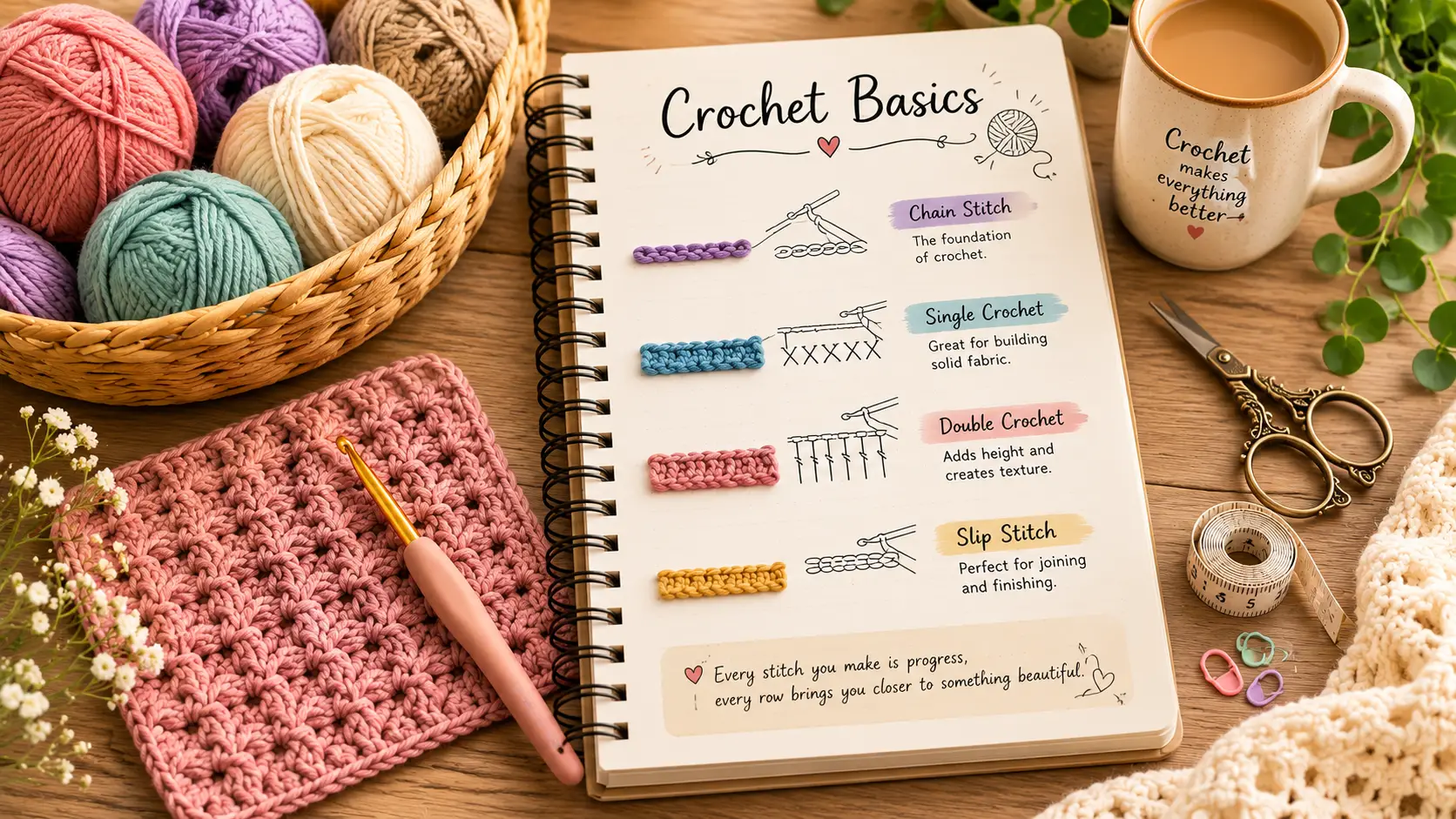
What Is Crochet Basics?
Crochet Basics is the foundational category of Crochets.top — the starting point for every person who is picking up a hook for the very first time. The guides in this category cover the complete set of skills, vocabulary, and knowledge that you need before you can meaningfully follow any crochet pattern or attempt any project.
Think of Crochet Basics as the alphabet of crochet. Just as you cannot read without knowing letters, you cannot follow a crochet pattern without understanding abbreviations, count stitches without knowing what a stitch looks like, or finish a project without knowing how to fasten off and weave in ends. Every topic in this category is a letter in that alphabet — individually small, collectively essential.
The category is organized into four clusters: Foundation Skills (making stitches and counting them), Reading and Understanding (patterns, abbreviations, vocabulary), Getting Started (supplies, difficulty, and comparison with knitting), and Finishing and Fixing (fastening off, weaving in ends, fixing mistakes). You do not need to read every guide before starting your first project, but working through the Foundation Skills cluster will give you everything you need to make your first piece of crochet fabric today.
Who This Is For
These guides are written for people who have never crocheted before, or who have tried and stopped and want to start fresh with a clear foundation. Every concept is explained from scratch with no assumed prior knowledge.
What You Will Be Able to Do
After working through the Foundation Skills and Reading clusters, you will be able to follow any beginner crochet pattern, identify and count your stitches, start and finish a project cleanly, and understand everything a pattern asks you to do.
Time Commitment
The slip knot and chain stitch can be learned in under an hour. A first complete project typically takes two to four casual sessions of one to two hours each. The full Crochet Basics knowledge base can be read through in two to three hours and referred back to as needed throughout your first several projects.
Your Crochet Learning Path
Seven sequential steps that take you from a hook and ball of yarn to a finished, polished crochet project — in the right order, nothing skipped.
Set Up Your Hook and Yarn
Before you make a single stitch, you need the right materials in hand. A 5.0 mm aluminum crochet hook paired with a smooth medium-weight yarn is the industry-standard starting point for a reason: this combination gives you stitches large enough to see clearly, motions that feel natural rather than cramped, and a pace that lets you observe what your hands are doing. Yarn choice matters too — pick a solid, light-colored, smooth yarn. Light colors let you see every stitch. Smooth texture shows you the structure of the work. Avoid fuzzy or novelty yarns until your hands know what they are doing.
Make Your First Slip Knot
The slip knot is the starting point of every crochet project ever made. It is a small adjustable loop that anchors the yarn to your hook and introduces you to the two key concepts you will use forever: the working yarn (the strand going toward the ball) and the tail (the short free end). Making a slip knot takes three steps: form a loop, pull a second loop through the first, and place it on the hook. It feels slightly awkward the first few times, then becomes automatic. Learning to distinguish working yarn from tail at this stage sets you up to understand every stitch instruction that follows.
Chain Your Foundation Row
The chain stitch is made by yarning over and pulling through — a motion you will repeat thousands of times across your crochet life. A row of chains is the foundation chain, the starting edge that almost every flat crochet project is built on. The key skill here is even tension: if your chains vary in size, the first row of stitches will be uneven and the piece will not sit flat. Work slowly, let the yarn flow steadily from your yarn hand, and aim for chains that are all the same size. You will know you have it when a finished chain lies flat and flexible like a loose braid.
Learn the Single Crochet Stitch
Single crochet is the foundation stitch of crochet and the first real stitch every beginner learns. It has just two steps after inserting the hook: yarn over and pull through the stitch, then yarn over again and pull through both loops. Repeat across the row. Single crochet produces a firm, tight fabric with a distinct woven texture. Working rows of single crochet into your foundation chain produces your first piece of real crochet fabric. Every other stitch you learn is a variation on this same insert-yarn over-pull-through sequence, so the single crochet is not just the first stitch — it is the template for understanding all the others.
Count Stitches and Rows
Counting is the skill that keeps everything else working. A wrong stitch count causes edges to slant; a wrong row count makes pieces the wrong size. The top of every crochet stitch forms a small V shape — count the Vs to count stitches. Count the ridges along the side edge to count rows. These counts only take seconds but prevent hours of rework. Develop the habit of counting at the end of every row when you are a beginner. As your hands build muscle memory and your count error rate drops, you can count less frequently — but in the early weeks, every-row counting is your best friend.
Read a Pattern and Understand Abbreviations
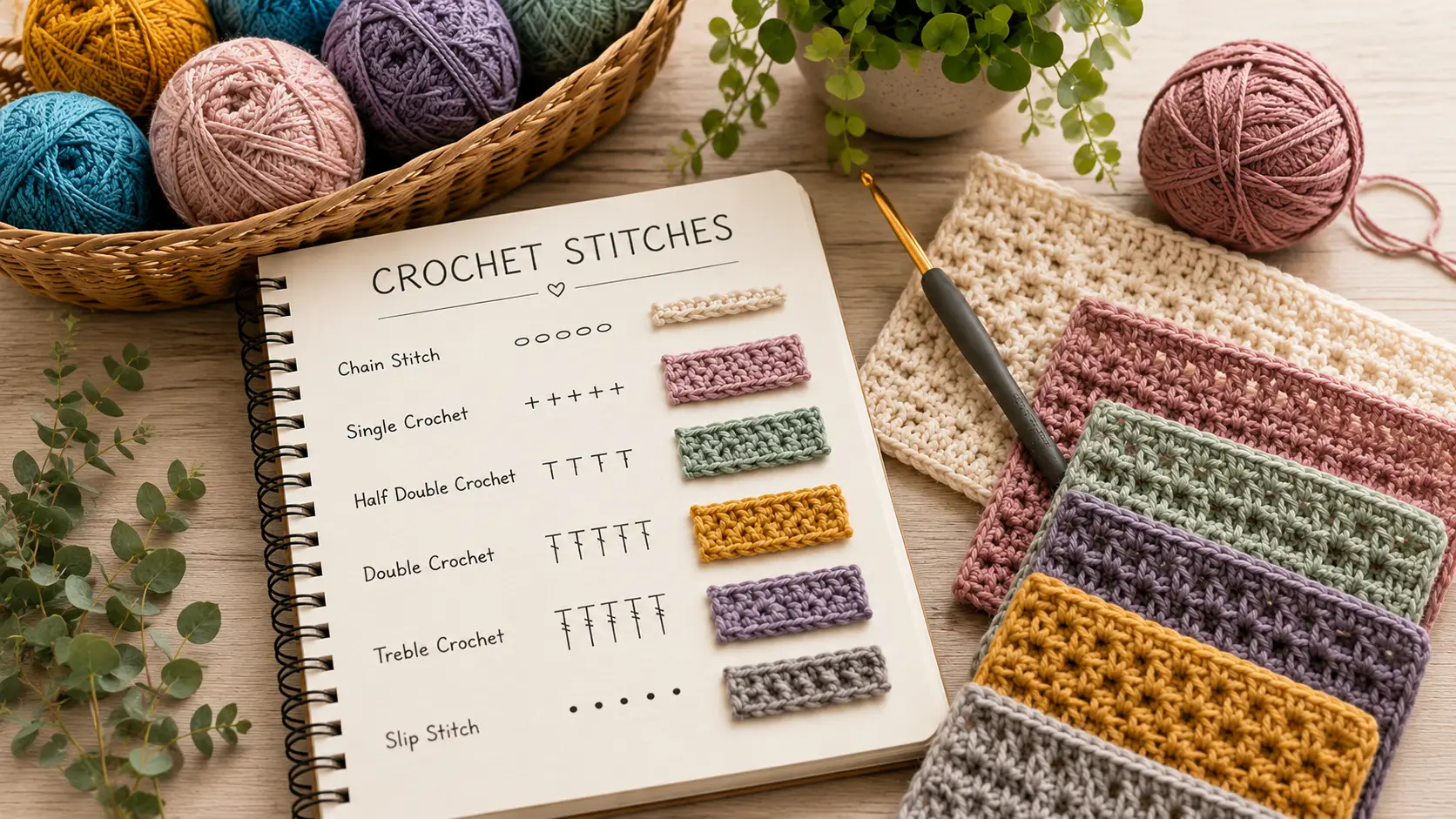
Patterns are written in shorthand — ch for chain, sc for single crochet, dc for double crochet — and understanding this shorthand opens every pattern ever written to you. Patterns also use repeat markers (asterisks and brackets) to compress long rows into compact instructions. The one critical detail is whether a pattern uses US or UK terminology: the same stitch names refer to different stitches in the two systems. Always check before starting. Once you can read a basic pattern, your project options expand from practice swatches to any beginner design you find.
Finish Your Work Neatly
A project is not done until the last stitch is secured and the yarn tails are woven in. Fastening off — cutting the yarn and pulling the tail through the last loop — locks your work so it cannot unravel. Weaving in ends using a tapestry needle through the backs of multiple stitches hides the tails and anchors them permanently. These finishing steps take a few minutes but are what transform a crochet piece from a work in progress into a finished object you can use, give, and be proud of.
Why Crochet Is Worth Learning
Crochet is a craft with an unusually short distance between first lesson and first finished object. With one hook and one ball of yarn, a complete beginner can make a real, useful dishcloth or scarf within their first week of learning. That speed of result is one of the reasons people who try crochet tend to stick with it — the feedback loop between practice and reward is tight enough to keep motivation high while skills are still developing.
Beyond the practicality, crochet offers something that many modern activities do not: tangible, lasting output from time that might otherwise be spent passively. Every hour of crochet produces something that exists in the physical world — something you made with your hands, that carries the texture of the yarn, the decisions you made about color and pattern, and the gradually improving skill your hands developed to make it.
The meditative quality of crochet is well-documented among its practitioners. The repetitive motions of yarning over and pulling through have a rhythm that many people find calming, particularly for managing stress and anxiety. Many committed crocheters describe it as the activity that allows them to be genuinely present in a way that screen-based entertainment does not.
Finally, crochet has a community. The crochet world, both online and in physical stitch groups, is known for being unusually welcoming and generous toward beginners. Questions asked in crochet forums receive patient, detailed answers. Local yarn shops frequently host beginner groups specifically to help new crocheters get started in person. Whatever question or problem arises, a knowledgeable crocheter is somewhere nearby and willing to help.

One hook, one yarn
First project in days
Meditative & calming
Welcoming community
Choosing Your First Hook and Yarn
The right materials make learning significantly easier. Here is exactly what to look for.
The Hook
Start with a 5.0 mm aluminum hook, labeled H-8 in US sizing. Aluminum is smooth — yarn glides freely — affordable, and durable. The 5.0 mm size pairs perfectly with worsted weight yarn and produces stitches that are easy to see and comfortable to work with.
The Yarn
Choose a smooth, solid, medium-weight yarn (labeled #4 or worsted) in a light color — cream, white, pale yellow. Light colors make stitch structure visible. Smooth texture lets you see where each stitch begins and ends. Avoid fuzzy, dark, or textured yarn while learning.
The Extras
Scissors to cut yarn and a tapestry needle to weave in ends are the only extras you need right away. A few locking stitch markers and a row counter are helpful but not urgent. Everything else can wait until a specific project asks for it.
For a full breakdown of every supply and why each matters — including what to skip — read the beginner supplies guide. For a deeper look at hook types, hook anatomy, and useful notions, see the crochet tools guide.
Browse Every Crochet Basics Article
Organized into four clusters — work through them in order or jump to whatever you need right now.

How to Make a Slip Knot for Crochet
Learn how to make a slip knot for crochet in three simple steps. The slip knot is the very first skill every beginner needs before chaining.

How to Crochet a Chain Stitch
Master the crochet chain stitch — the foundation chain that begins almost every crochet project. A clear step-by-step guide for absolute beginners.

How to Count Crochet Stitches
Learn how to count crochet stitches correctly so your edges stay straight and your projects keep their shape. A simple beginner guide.

How to Count Crochet Rows
A simple guide to counting crochet rows so you always know how far along your project is. Learn to read rows in single crochet and taller stitches.

How to Read a Crochet Pattern
Decode any crochet pattern with confidence. Learn abbreviations, repeats, brackets, US vs UK terms, and how to read crochet charts step by step.
Crochet Abbreviations Guide: US & UK Chart for Beginners
A complete crochet abbreviations guide with US and UK charts. Decode ch, sc, dc, hdc, tr, sl st and more so you can read any pattern.
Crochet Terms Every Beginner Should Know
A beginner-friendly glossary of crochet terms — from yarn over and turning chain to gauge, frogging, and WIP — so patterns finally make sense.
Is Crochet Easy? An Honest Beginner's Answer
Is crochet easy to learn? An honest look at what makes crochet beginner-friendly, what feels tricky at first, and how quickly you can get comfortable.
Crochet vs Knitting for Beginners: Which Is Easier?
Crochet vs knitting for beginners — compare tools, learning curve, speed, and cost to decide which craft is the easier place to start.
Is Knitting Easier Than Crochet? Honest Pros and Cons
Is knitting easier than crochet? An honest comparison of the learning curve, mistake recovery, and which craft absolute beginners pick up faster.
What Supplies Do You Need to Crochet? Beginner Starter List
A complete beginner starter list of crochet supplies — the three essentials plus helpful extras, and what you can skip when you are just starting out.
Beginner Crochet Tools Guide: Hooks, Notions & Must-Haves
A friendly guide to beginner crochet tools — hook types and materials, hook anatomy, and the notions that make learning crochet easier.
How to Fasten Off Crochet: Secure Your Work the Right Way
Learn how to fasten off crochet so your finished work never unravels. A clear beginner guide to securing the final stitch and handling the tail.
How to Weave in Ends in Crochet So They Never Come Loose
Learn how to weave in ends in crochet for a neat, invisible, secure finish. Step-by-step guidance so your yarn tails never pop back out.
What Is Frogging in Crochet? Meaning, Origin & How to Do It
What is frogging in crochet? Learn what the term means, where it comes from, when to frog your work, and how to rip back stitches safely.
12 Common Crochet Mistakes Beginners Make (and How to Fix Them)
The most common crochet mistakes beginners make — uneven tension, lost stitches, curling edges — and simple, practical ways to fix and prevent each one.
All Crochet Basics Guides
The complete, up-to-date list of every basics guide on the site.
What Is Crochet Thread? A Guide to Thread and Sizes
What is crochet thread? Learn what crochet thread is, how it differs from yarn, the thread sizes and what they mean, the hooks you use, and the projects thread suits.
What Does RS Mean in Crochet? (Right Side Explained)
What does RS mean in crochet? Learn that RS stands for right side, the front of your work, how it differs from WS or wrong side, and why patterns tell you which side is which.
What Does BO Mean in Crochet? (Bind Off and Bobble)
What does BO mean in crochet? Learn that BO usually means bind off, which is the same as fastening off, and can sometimes mean bobble, plus how to tell which from the pattern.
What Does BLO Mean in Crochet? Back Loop Only Explained
What does BLO mean in crochet? Learn that BLO stands for back loop only, how to work into the back loop, the ridges and stretch it creates, and when patterns use it.
When Did Crochet Begin? A Short History of Crochet
When did crochet begin? A short history of crochet, from its uncertain early origins and the boom of Irish crochet lace to its Victorian popularity and modern revival.
What Is Crochet? A Simple Introduction to the Craft
What is crochet? A simple introduction to the craft of making fabric from yarn with a hook, how it works, what you can make, and how it differs from knitting.
Is Knitting Easier Than Crochet? Honest Pros and Cons
Is knitting easier than crochet? An honest comparison of the learning curve, mistake recovery, and which craft absolute beginners pick up faster.
What Is Frogging in Crochet? Meaning, Origin & How to Do It
What is frogging in crochet? Learn what the term means, where it comes from, when to frog your work, and how to rip back stitches safely.
How to Count Crochet Rows
A simple guide to counting crochet rows so you always know how far along your project is. Learn to read rows in single crochet and taller stitches.
Crochet Terms Every Beginner Should Know
A beginner-friendly glossary of crochet terms — from yarn over and turning chain to gauge, frogging, and WIP — so patterns finally make sense.
Beginner Crochet Tools Guide: Hooks, Notions & Must-Haves
A friendly guide to beginner crochet tools — hook types and materials, hook anatomy, and the notions that make learning crochet easier.
Crochet vs Knitting for Beginners: Which Is Easier?
Crochet vs knitting for beginners — compare tools, learning curve, speed, and cost to decide which craft is the easier place to start.
Is Crochet Easy? An Honest Beginner's Answer
Is crochet easy to learn? An honest look at what makes crochet beginner-friendly, what feels tricky at first, and how quickly you can get comfortable.
12 Common Crochet Mistakes Beginners Make (and How to Fix Them)
The most common crochet mistakes beginners make — uneven tension, lost stitches, curling edges — and simple, practical ways to fix and prevent each one.
How to Count Crochet Stitches
Learn how to count crochet stitches correctly so your edges stay straight and your projects keep their shape. A simple beginner guide.
How to Weave in Ends in Crochet So They Never Come Loose
Learn how to weave in ends in crochet for a neat, invisible, secure finish. Step-by-step guidance so your yarn tails never pop back out.
How to Fasten Off Crochet: Secure Your Work the Right Way
Learn how to fasten off crochet so your finished work never unravels. A clear beginner guide to securing the final stitch and handling the tail.
Crochet Abbreviations Guide: US & UK Chart for Beginners
A complete crochet abbreviations guide with US and UK charts. Decode ch, sc, dc, hdc, tr, sl st and more so you can read any pattern.
How to Read a Crochet Pattern
Decode any crochet pattern with confidence. Learn abbreviations, repeats, brackets, US vs UK terms, and how to read crochet charts step by step.
What Supplies Do You Need to Crochet? Beginner Starter List
A complete beginner starter list of crochet supplies — the three essentials plus helpful extras, and what you can skip when you are just starting out.
How to Crochet a Chain Stitch
Master the crochet chain stitch — the foundation chain that begins almost every crochet project. A clear step-by-step guide for absolute beginners.
How to Make a Slip Knot for Crochet
Learn how to make a slip knot for crochet in three simple steps. The slip knot is the very first skill every beginner needs before chaining.
Frequently Asked Questions
How long does it take to learn crochet?
Most beginners can learn the slip knot, chain, and single crochet in a single afternoon. Building comfortable competence — where crochet feels genuinely enjoyable rather than effortful — typically takes two to four finished projects across two to four weeks of casual practice. Every person is different, but the basics truly do come quickly.
What is the easiest crochet stitch for beginners?
The single crochet is the simplest true stitch. It uses just two motions after inserting the hook — yarn over and pull through, yarn over and pull through again — and produces a firm, dense fabric that is easy to see, count, and learn from. Almost every beginner tutorial starts here because it teaches the foundational mechanic shared by all crochet stitches.
What do I need to start crocheting?
You need three things: a 5.0 mm crochet hook, a ball of smooth medium-weight (worsted / #4) yarn in a light color, and a pair of scissors. A tapestry needle for weaving in ends is also helpful. That is genuinely all. Everything else — stitch markers, row counters, project bags — can be added when specific projects call for them.
What should I make as my first crochet project?
A simple rectangular dishcloth or a long scarf worked entirely in single crochet is the ideal first project. Both require only the foundation chain and the single crochet stitch, produce a real usable finished object, and give you many rows of practice to develop even tension. Keep it simple for the first project and save ambitious designs for once you have a few rows under your belt.
What is the difference between US and UK crochet terms?
US and UK patterns use the same stitch names for completely different stitches. A US single crochet equals a UK double crochet. A US double crochet equals a UK treble crochet. This mismatch affects every stitch in a pattern. Always check which system a pattern uses before you start — patterns usually specify this in their header or notes section.
Continue Your Crochet Education
Once the basics are solid, explore these next categories.
Make Your First Slip Knot Right Now
The slip knot takes five minutes to learn and is the first step of every crochet project. Begin there and everything else follows naturally.
Start With the Slip Knot →