Crochet Hooks, Explained
Your hook is the one tool your hands never put down — and choosing the right one changes everything about how crochet feels. This is the master guide to hooks: sizes and conversions, anatomy, materials, ergonomic and specialty options, and how to pair a hook with any yarn.
What Is a Crochet Hook?
A crochet hook is the single tool that defines the craft — a slender shaft with a hooked end that catches yarn and pulls it through loops to build fabric, one stitch at a time. Where knitting uses two needles holding many live stitches, crochet uses one hook and one active loop, which is a big part of what makes it so approachable for beginners.
But not all hooks are the same, and the differences matter more than newcomers expect. Hooks vary in size (the diameter that sets your stitch size), in material (which changes how yarn glides and how the hook feels in your hand), and in head shape and handle (which affect tension and comfort). The right combination can make crochet feel effortless; the wrong one can make even simple stitches a struggle.
Hooks work hand in hand with yarn: the two are chosen together, because a hook's size is matched to a yarn's weight to produce the intended fabric and gauge. That makes hook knowledge a natural companion to our crochet yarn guide and the gauge and tension fundamentals in crochet basics.
Size Sets the Stitch
A hook’s number is the diameter of its shaft in millimeters — and stitches form around that shaft. Bigger hook, bigger stitches, looser fabric; smaller hook, smaller stitches, denser fabric.
Material Sets the Feel
Aluminum glides, bamboo grips, plastic is light, steel is tiny. The material changes how fast you work and how your hands feel after an hour of stitching.
Just Starting?
Reach for a 5.0 mm aluminum hook with worsted-weight yarn. It’s the classic, can’t-go-wrong first setup.
Why Your Hook Choice Matters
The hook determines your gauge — the size of your stitches — which decides whether a hat fits, a blanket reaches the right dimensions, and a garment turns out as designed. Two crocheters using the same yarn and pattern but different hook sizes will produce different-sized results. This is why matching (and sometimes adjusting) your hook is the first step to hitting a pattern’s measurements.
The hook also shapes your comfort and speed. A smooth hook and a comfortable handle let you work for hours without strain; a rough or thin hook can cause hand fatigue and slow you down. For anyone who crochets often — or lives with arthritis or hand pain — the right hook is the difference between a relaxing hobby and an achy one.
Finally, the hook affects your stitch quality and tension. A hook whose head grips yarn well produces even, consistent stitches; a poorly-shaped or wrong-sized hook can split yarn, drop loops, or make stitches hard to work into. Getting comfortable with a hook you like is one of the quiet secrets to neat, even crochet — and it pairs directly with the tension habits taught across the basics.
The Anatomy of a Crochet Hook
Every hook has five parts, and each one does a job. Understanding them explains why hooks feel and behave differently.
Head (point)
The tip that you insert into stitches. Its shape — pointed or rounded — affects how easily it slips into the fabric.
Throat
The angled groove just below the head that catches and holds the yarn as you pull it through. A deeper throat grips yarn more firmly.
Shaft
The straight section whose diameter sets your stitch size. Stitches should form around the shaft — not the narrower head — for consistent size.
Thumb rest
The flattened section that gives your thumb a natural resting place and helps you orient and rotate the hook without looking.
Handle
The section you grip. Standard handles are thin and round; ergonomic handles are thicker and cushioned for comfort.
The key takeaway
Always let stitches form around the shaft, not the narrower head — working over the head is a common cause of tight, uneven stitches.
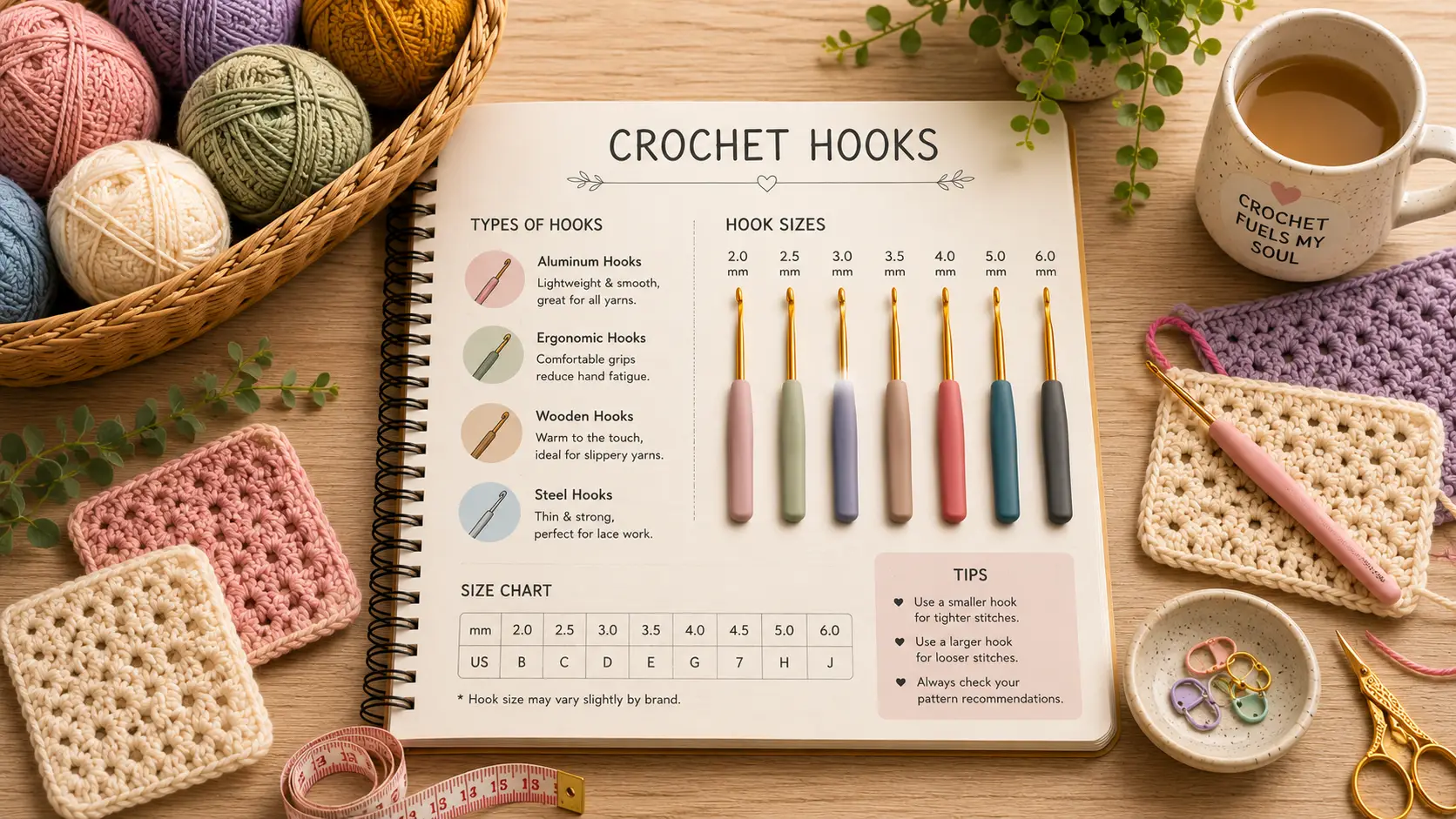
Crochet Hook Size Chart
Metric (mm) is the universal standard — it measures the shaft’s actual diameter. US letter/number sizes correspond but can vary slightly by brand, so go by millimeters when it counts.
| Metric | US Size | Typical Yarn | Best For |
|---|---|---|---|
| 2.25 mm | B-1 | Lace / fingering | Fine thread and delicate work |
| 3.5 mm | E-4 | Sport (#2) | Baby items, lightweight pieces |
| 4.0 mm | G-6 | DK / light (#3) | Garments, versatile projects |
| 5.0 mm | H-8 | Worsted (#4) | Most common — blankets, hats, amigurumi |
| 5.5 mm | I-9 | Worsted / aran (#4) | Beginner-friendly all-rounder |
| 6.0 mm | J-10 | Aran (#4) | Warm garments, thicker fabric |
| 6.5 mm | K-10.5 | Bulky (#5) | Quick blankets, scarves, cowls |
| 8.0 mm | L-11 | Bulky (#5) | Chunky, fast projects |
| 9.0 mm | M/N-13 | Super bulky (#6) | Thick blankets and baskets |
| 10 mm+ | N/P-15+ | Jumbo (#7) | Giant blankets, arm-style crochet |
The 5.0 mm (H-8) hook is the most useful all-rounder and the standard for beginners. For the full chart — including tiny steel thread hooks and US/UK conversions — see crochet hook sizes, and pair it with the right yarn using which hook for your yarn.
Crochet Hook Materials
The material changes how yarn glides, how the hook feels, and which projects it suits. Here are the four you’ll meet most.
Aluminum
The smooth, all-purpose favorite. Yarn glides freely, the size is stamped on the handle, it's inexpensive, and it lasts for years. The standard first hook for most beginners.
Bamboo & Wood
Warm to the touch with a slightly grippy surface that stops stitches sliding off too freely — helpful if your yarn is slippery. Quieter and lighter than metal, and gentle on the hands.
Plastic & Acrylic
Light and inexpensive, common in large and jumbo sizes where metal would be heavy. Fine for beginners and big-yarn projects, though surfaces can develop rough spots over time.
Steel
Very small hooks used for fine thread crochet, lace, and doilies. They use their own numbering system (higher number = smaller hook) and are not used with regular yarn.
Deciding between them? Compare all four in depth in crochet hook materials, and if comfort is a priority, look at ergonomic crochet hooks.
Browse Every Hook Guide
Each guide below goes deep on one part of choosing and using hooks — sizes, materials, comfort, and technique. Start wherever you need.
Crochet Hook Sizes
The full metric, US, and steel size chart — with conversions and yarn pairings.
Read the guideBest Hooks for Beginners
Exactly which hook to buy first — size, material, and what to skip.
Read the guideCrochet Hook Materials
Aluminum, bamboo, plastic, and steel compared — how each feels and performs.
Read the guideErgonomic Crochet Hooks
Cushioned handles that ease hand strain, arthritis, and long crochet sessions.
Read the guideHow to Hold a Crochet Hook
The knife grip vs the pencil grip — find the hold that feels natural to you.
Read the guideWhich Hook for Your Yarn
Match hook to yarn weight and dial in gauge for the right finished size.
Read the guideInline vs Tapered Hooks
How the two head shapes catch yarn differently — and which might suit you.
Read the guideTunisian Crochet Hooks
Long and cabled hooks that hold many loops for Tunisian crochet.
Read the guideHow to Choose a Hook
A complete buying guide — size, material, head shape, handle, and budget.
Read the guideCrochet Hook Care
Clean, store, and organize your hooks so they last and stay easy to find.
Read the guideAll Crochet Hook Guides
The complete, up-to-date list of every hook guide on the site.
Crochet Hook Care: How to Clean, Store, and Organize Hooks
Simple crochet hook care tips. Learn how to clean your hooks, store them safely, keep bamboo and wood in good shape, and organize your collection so hooks last.
How to Choose a Crochet Hook: A Complete Buying Guide
How to choose a crochet hook, step by step. Learn to pick the right size, material, head shape, and handle for your yarn, project, and hands, whatever your budget.
Tunisian Crochet Hooks: What They Are and How to Choose One
A guide to Tunisian crochet hooks. Learn how these long and cabled hooks differ from regular hooks, the types available, and how to pick the right one for Tunisian crochet.
Inline vs Tapered Crochet Hooks: What Is the Difference?
Inline vs tapered crochet hooks explained. Learn how the two head shapes catch yarn differently, how each affects your stitches and tension, and which might suit you.
What Crochet Hook Size for Your Yarn? A Simple Pairing Guide
Learn which crochet hook size to use with your yarn. A simple pairing guide by yarn weight, how to use the label, and how to adjust your hook to match gauge.
How to Hold a Crochet Hook: Knife Grip vs Pencil Grip
Learn how to hold a crochet hook using the knife grip or the pencil grip, plus how to hold the yarn for even tension. Simple guidance to find the hold that suits you.
Ergonomic Crochet Hooks: Do You Need Them and Which to Pick
A guide to ergonomic crochet hooks. Learn how they ease hand strain and arthritis, what to look for in a comfortable handle, and whether they are worth it for you.
Crochet Hook Materials: Aluminum, Bamboo, Plastic, and Steel
A guide to crochet hook materials. Compare aluminum, bamboo and wood, plastic, and steel hooks by feel, glide, grip, and best use, so you can pick the right one.
Best Crochet Hooks for Beginners: What to Buy First
The best crochet hooks for beginners, explained. Learn which size and material to buy first, whether to get a set, and simple tips that make learning crochet easier.
Crochet Hook Sizes: The Complete Chart and Conversions
A complete guide to crochet hook sizes, with metric and US sizes, steel thread hooks, conversions, and the yarn each size suits. Find the right hook size for any project.
Inline vs Tapered Hooks
Beyond size and material, hooks differ in the shape of their head. Inline hooks (often called Bates-style) have a head that sits in line with the shaft, with a deeper, more pointed throat that grips the yarn firmly and helps keep stitches even and consistent.
Tapered hooks (often called Boye-style) have a rounder head that tapers into the shaft, letting the hook glide smoothly through stitches with less resistance. Neither is better — it comes down to personal preference, and many crocheters feel strongly about one once they’ve tried both. Explore the difference in inline vs tapered crochet hooks.
Grip: Knife vs Pencil
There are two main ways to hold a hook. The knife grip holds the hook over the top like a dinner knife, with the palm over the handle — this offers control and is easier on the wrist for many. The pencil grip holds the hook like a pencil, between thumb and forefinger, which some find more precise.
Both are correct — use whichever feels natural, and don’t be afraid to switch. Your grip works together with how you hold the yarn to control tension, a skill covered in how to hold a crochet hook and throughout the stitch library.
Common Hook Mistakes
- Using the wrong size for the yarn. Too small makes stiff, cramped fabric; too big makes loose, gappy fabric. Start from the label’s suggested size.
- Working over the head, not the shaft. Forming stitches on the narrow head makes them too tight and uneven. Let each stitch settle onto the shaft.
- Ignoring gauge. If your project comes out the wrong size, change hook size — not your stitches — until your gauge matches the pattern.
- Pushing through hand pain. Aching hands mean it’s time for an ergonomic hook and breaks — not something to power through.
Caring for Your Hooks
Hooks are low-maintenance, but a little care keeps them smooth and easy to find. Wipe them occasionally to remove oils and fiber residue that can make yarn drag. Keep bamboo and wooden hooks away from moisture so they don’t warp, and store all hooks somewhere they won’t get bent, scratched, or lost.
A simple hook roll, case, or jar keeps your sizes organized and visible — a real time-saver once you own more than a couple. As you take on different yarn weights and projects, your collection will naturally grow to cover the sizes you use most. Full tips are in crochet hook care, and you can put your hooks to work on the projects in our beginner pattern hub.
Crochet Hooks: Frequently Asked Questions
What size crochet hook should a beginner use?
A 5.0 mm (US H-8) or 5.5 mm (US I-9) hook is the ideal beginner size. It pairs perfectly with medium-weight (worsted / #4) yarn — the most beginner-friendly yarn — and makes stitches large enough to see clearly. An aluminum hook in this size is the classic first choice.
What do crochet hook sizes mean?
A hook's size is the diameter of its shaft, measured in millimeters. The shaft is where each stitch is formed, so a bigger number means a bigger hook and bigger stitches. Sizes range from tiny steel hooks under 2 mm for thread work up to 15 mm and larger for chunky yarn.
What is the most common crochet hook size?
The 5.0 mm (US H-8) hook is the most common and versatile size. It matches worsted-weight yarn, which is the most widely used yarn, and suits blankets, hats, amigurumi, and most beginner projects. Many patterns are written for this exact hook.
What are crochet hooks made of?
The most common materials are aluminum (smooth and all-purpose), bamboo or wood (warm and grippy), plastic (light and inexpensive, common in large sizes), and steel (tiny hooks for fine thread). Ergonomic hooks add a cushioned handle to any of these for comfort.
What is the difference between US and metric crochet hook sizes?
Metric sizes (in millimeters) measure the hook's actual diameter and are the universal standard. US sizes use letters and numbers (like H-8) that correspond to metric sizes but can vary slightly by brand. Always go by the millimeter measurement when precision matters.
Are ergonomic crochet hooks worth it?
If your hands tire, cramp, or ache while crocheting, yes. Ergonomic hooks have a thicker, cushioned, shaped handle that reduces strain, which helps during long sessions and for anyone with arthritis or hand pain. The hook head is the same, so your stitches don't change — only your comfort.
How do I know which hook to use with my yarn?
Every yarn label suggests a hook size that suits that yarn's weight — this is your reliable starting point. As a guide: worsted (#4) uses about 5.0–5.5 mm, DK (#3) about 4.0–5.0 mm, and bulky (#5) about 6.5–9 mm. Adjust up or down a size to match a pattern's gauge.
What is an inline vs tapered crochet hook?
This refers to the head shape. Inline hooks (Bates-style) have a head in line with the shaft and a deeper, more pointed throat that grips yarn firmly and keeps stitches even. Tapered hooks (Boye-style) have a rounder, tapered head that glides smoothly. Many crocheters prefer one or the other — it's worth trying both.
Hooks Are Half the Equation
Pair your hook with the right yarn, stitches, and techniques.
Get the Right First Hook
One good hook is all you need to begin. Here’s exactly which size and material to reach for on day one.
Best Hooks for Beginners →