Crochet Shapes, From Flat Circles to 3D Forms
Every crochet object that is not a plain rectangle is a shape — and every shape is built from the same two moves: increasing and decreasing. This is the master guide to the geometry of crochet: how circles, spheres, ovals, and cones are constructed, the formulas that make them perfect, and how to fix them when they go wrong.
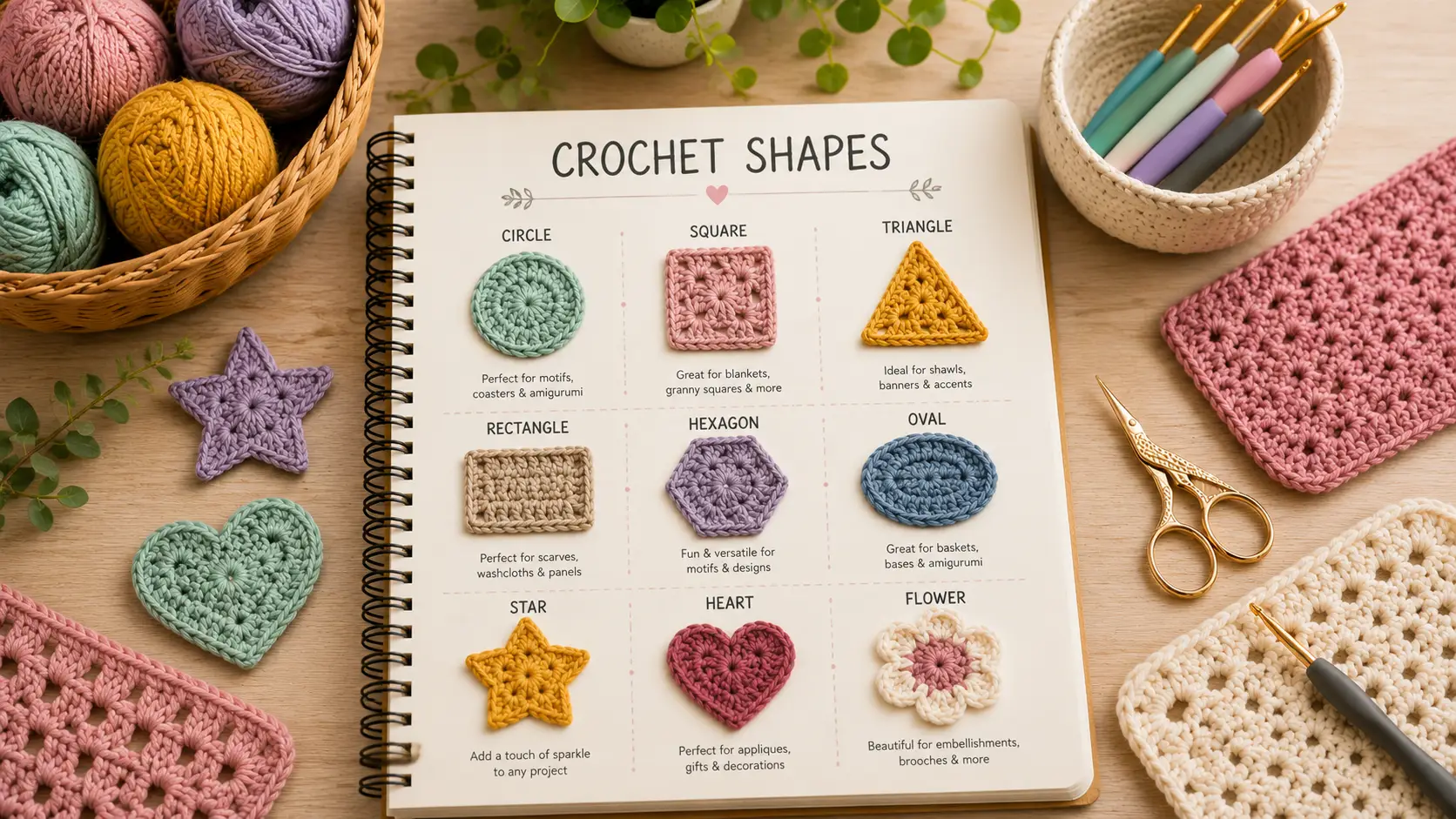
What Are Crochet Shapes?
A crochet shape is any geometric form you create by arranging stitches and controlling where the fabric grows and shrinks. A flat circle, a round ball, a tapering cone, a stretched oval, a tube — these are all crochet shapes, and they are the building blocks of nearly every project beyond a flat scarf or blanket. If stitches are the bricks of crochet, shapes are the architecture.
What makes shapes possible is the relationship between stitch count and fabric. When you keep the same number of stitches every row or round, the fabric stays the same width. When you add stitches, it widens; when you remove them, it narrows. By choosing exactly where and how often to add or remove stitches, you sculpt flat fabric into circles, spheres, and three-dimensional forms. Shaping is applied geometry, worked with a hook.
This category breaks down every major crochet shape — how it is constructed, the formula that governs it, the projects it builds, and how to troubleshoot it. Shapes draw directly on the shaping techniques in our crochet techniques category and the stitches in the stitch library, bringing them together into finished, dimensional form.
The Two Moves That Build Everything
Every crochet shape comes down to increasing (adding stitches to widen) and decreasing (removing stitches to narrow). Master these two moves and their placement, and you can build any shape.
Flat vs Three-Dimensional
Shapes are either flat (circles, ovals, squares that lie flat) or three-dimensional (spheres, cones, tubes that hold form). The difference is entirely in the rhythm of increases and decreases.
Built on Technique
Shapes assume you can work a magic ring, increase, and decrease. If those feel new, start there first.
How Crochet Shapes Are Created
Every crochet shape is governed by one principle: the rate at which stitches are added or removed determines the form. Add stitches quickly and the fabric flares; add them slowly and it curls inward; keep the count steady and it rises straight up as a tube. By scripting this rate round by round, a pattern designer turns flat fabric into a precise three-dimensional object.
A flat circle, for example, must add a fixed number of stitches every round — no more, no less — because a circle’s circumference grows at a constant rate as its radius increases. Add too few and the fabric cannot keep up, so it cups into a bowl; add too many and there is excess fabric, so it ruffles into a frill. The crochet circle formula captures exactly this balance.
A sphere takes the same idea further: it increases like a circle to reach its widest point, works even rounds through its middle, then decreases symmetrically to close — mirroring the increase schedule in reverse. A cone increases slowly and steadily so it widens gradually into a point. An oval increases only at its two ends, leaving the sides straight. Each shape is just a different script of increases, even rounds, and decreases, all built on the technique of working in the round.
The Three Families of Crochet Shapes
Every crochet shape belongs to one of three families, defined by how its increases and decreases are arranged.
Flat Shapes
Circles, ovals, squares, hexagons, and other discs that lie flat. Built by increasing outward from a center while keeping the fabric flat — the basis of coasters, motifs, rugs, and bag bases.
Round & Tubular Shapes
Cylinders and tubes worked in continuous rounds without increasing — the straight body of hats, bags, sleeves, and amigurumi limbs. Built by working even rounds after an initial flat base or ring.
Three-Dimensional Shapes
Spheres, cones, ovoids, and sculptural forms. Built by combining increases (to widen), even rounds (to build height), and decreases (to close) — the architecture of amigurumi and 3D crochet.
The Crochet Circle Formula
A flat circle follows a simple rule: increase by the same number every round, equal to your starting stitch count. That number depends on the stitch height you use.
| Round | Single Crochet | Half Double | Double Crochet | Notes |
|---|---|---|---|---|
| Round 1 | 6 | 8 | 12 | Worked into a magic ring |
| Round 2 | 12 | 16 | 24 | Increase in every stitch |
| Round 3 | 18 | 24 | 36 | Increase spaced every 2nd st |
| Round 4 | 24 | 32 | 48 | Increase spaced every 3rd st |
| Round 5 | 30 | 40 | 60 | Increase spaced every 4th st |
| Each round | +6 | +8 | +12 | Add the starting number every round |
The taller the stitch, the more stitches it takes to fill a round — which is why double crochet circles add 12 per round while single crochet adds only 6. For the full breakdown, including how to keep the increases staggered, see the crochet circle formula guide and how to make a flat circle.
Browse Every Crochet Shape
Each shape and shaping topic below has its own in-depth guide — step-by-step construction, formulas, troubleshooting, and project examples.
The Crochet Circle
The foundation of all round crochet — a flat disc built with evenly spaced increases.
Explore this shapeWorking in the Round
The core technique behind circles, spheres, and tubes — rounds vs spirals explained.
Explore this shapeThe Sphere / Ball
Increase, work even, then decrease to form a perfect ball — the heart of amigurumi.
Explore this shapeThe Oval
A stretched circle worked around a foundation chain — the base of many bags and rugs.
Explore this shapeThin Cones
Gradual, controlled increases create points, horns, hats, and ice-cream cones.
Explore this shapeThe Circle Formula
The simple math that makes any flat circle lie perfectly flat, in any stitch.
Explore this shapeSphere Calculator
Plan a sphere of any size — increase, even, and decrease rounds worked out for you.
Explore this shapeWhy Circles Curl
Diagnose curling and ruffling, and understand the geometry behind a flat circle.
Explore this shapeFlat Circle Guide
Every method to keep a circle flat — spacing, hooks, tension, and stitch choice.
Explore this shapeShape Troubleshooting
A complete problem-solver for curling, ruffling, lopsided, and gappy shapes.
Explore this shapeAll Crochet Shape Guides
The complete, up-to-date list of every shape guide on the site.
Crochet Shape Troubleshooting: Fix Curling, Ruffling & Lopsided Shapes
The complete crochet shape troubleshooting guide — fix curling, ruffling, lopsided, gappy, and pointed shapes. Diagnose by symptom with clear causes and solutions.
Crochet Sphere Calculator: Plan a Ball of Any Size
How to calculate a crochet sphere of any size — the increase, even, and decrease schedule, how many rounds you need, the sphere math, and a worked example for amigurumi.
Crochet Circle Formula: The Math for a Perfectly Flat Circle
The complete crochet circle formula — increases per round for single, half double, and double crochet, the geometry behind it, staggering, and how to scale it to any size.
How to Make a Flat Crochet Circle (Every Method That Works)
How to make a perfectly flat crochet circle — correct increases, staggering, hook and tension fixes, the magic number per stitch, blocking, and a flat-circle checklist.
Why Crochet Circles Curl (and How the Geometry Works)
Why do crochet circles curl into a bowl or ruffle into a frill? Understand the geometry of increasing, the circle formula, and the exact causes of curling and ruffling.
How to Crochet Thin Cones: Gradual Shaping for Points & Horns
Learn how to crochet thin cones — slow, controlled increases for points, horns, hats, and ice-cream shapes. The cone formula, construction principles, mistakes, and troubleshooting.
How to Crochet an Oval: The Stretched-Circle Shaping Guide
Learn how to crochet a flat oval — working around both sides of a foundation chain, where to place increases, the oval formula, common mistakes, troubleshooting, and projects.
How to Crochet a Sphere (Ball): The Amigurumi Shaping Guide
Learn how to crochet a sphere or ball — the increase, even, and decrease schedule, the magic ring start, stuffing, common mistakes, and the sphere formula for any size.
How to Crochet a Rectangle Granny Square (Granny Rectangle)
Learn how to crochet a rectangle granny square, or granny rectangle, worked in rounds around a starting chain. See how to place the corners and keep the sides even.
Working in the Round: Joined Rounds vs Spirals Explained
Master working in the round in crochet — joined rounds vs continuous spirals, starting methods, stitch markers, the jog, common mistakes, and troubleshooting.
How to Crochet a Solid Granny Square (No Holes)
Learn how to crochet a solid granny square with no holes. See how to work the corners and sides in rounds for a dense, gap free square, plus tips and common mistakes.
How to Crochet a Bowl (Flat Base to Rising Sides)
Learn how to crochet a bowl or basket by working a flat circle base, then stopping the increases so the sides rise. See how to control the shape and the projects it suits.
How to Crochet a Half Circle (Semicircle Shaping)
Learn how to crochet a half circle, or semicircle, by working a flat circle in rows. See the increase spacing that keeps it flat, plus tips and the projects it suits.
How to Crochet a Circle: The Complete Flat Circle Tutorial
Learn how to crochet a flat circle step by step — the magic ring start, the circle formula, staggering increases, common mistakes, troubleshooting, and projects.
How to Crochet a Triangle (Increase or Decrease Methods)
Learn how to crochet a triangle using the increase and decrease methods. See how to shape triangles for shawls, bunting, and more, plus tips for neat, even points.
How to Crochet a Rectangle (Straight, Even Sides)
Learn how to crochet a rectangle with straight, even sides. See how to start with a foundation chain, work even rows, keep your edges straight, and the projects it builds.

Increase
Work even
Decrease
How Three-Dimensional Shapes Are Built
Three-dimensional crochet — the architecture of amigurumi — follows a clear three-phase script: increase, work even, decrease. You increase to widen the form to its broadest point, work straight rounds to give it height or a middle, then decrease to taper and close it. Change the timing of these phases and you change the shape entirely.
A sphere increases steadily, works a few even rounds at its equator, then decreases on the exact reverse schedule, producing a symmetrical ball. A cone increases slowly and never works fully even, so it tapers to a point. A cylinder skips increasing and decreasing altogether, working even rounds for a straight tube. An egg or ovoid uses uneven increase and decrease phases for its asymmetric ends.
All of this depends on clean decreasing — especially the invisible decrease for smooth amigurumi — and on keeping an accurate stitch count, a habit grounded in the crochet basics.
Common Shaping Mistakes
- Increasing too slowly → cupping. Too few stitches per round and the circle curls up into a bowl. Add the correct number for your stitch height.
- Increasing too quickly → ruffling. Too many stitches and the edges wave and frill. Reduce the increases per round to flatten it.
- Stacking increases → corners. Increases placed directly above each other turn a circle into a hexagon. Stagger them round to round.
- Losing the count → lopsided shapes. Without a stitch marker and a per-round count, shapes drift out of symmetry. Mark every round.
Work through every shape problem in our shape troubleshooting guide.
Planning & Practicing Shapes
The fastest way to learn shaping is to make each shape in isolation. Crochet a flat circle and check that it lies flat without curling or ruffling — that single exercise teaches the whole increase rhythm. Then make a sphere to learn how decreasing mirrors increasing, and a cone to feel gradual, partial increasing. Each shape is a self-contained lesson.
Use a smooth, light-colored, medium-weight yarn and a stitch marker so you can see your stitches and track each round clearly. Tension and gauge matter here too: a shape worked at uneven tension distorts, and a looser gauge than a pattern intends leaves gaps that show stuffing in amigurumi. Keep your tension firm and even for crisp, well-defined shapes.
Above all, count every round and stagger your increases. Most shaping problems are simply count problems in disguise — and catching them one round early, as our common mistakes guide stresses, saves hours of frogging.
What You Can Make With Crochet Shapes
Shapes are the foundation of almost every dimensional project. Here is where each one leads.
Circles
Coasters, placemats, rugs, mandalas, hat crowns, bag bases, and granny-circle motifs.
Spheres
Amigurumi heads and bodies, balls, beads, ornaments, and toy components.
Ovals
Oval bags, baskets, rugs, slippers, and the bases of many amigurumi animals.
Cones
Hats, ice-cream and carrot amigurumi, horns, party hats, and pointed accents.
Tubes
Hat bodies, bags, arms and legs of toys, cozies, and sleeves.
Combined forms
Complex amigurumi and sculptures built by joining circles, spheres, cones, and tubes.
Ready to put shapes to work? Many shaped projects — from amigurumi to round bags — are waiting in the beginner pattern hub.
Crochet Shapes: Frequently Asked Questions
What are crochet shapes?
Crochet shapes are the geometric forms — flat circles, squares, ovals, and three-dimensional spheres, cones, and tubes — created by arranging stitches and placing increases and decreases. Shapes are the foundation of every project that is not a plain rectangle, from coasters and hats to amigurumi toys.
How are crochet shapes made?
Crochet shapes are made by controlling where you add stitches (increases) and remove them (decreases). Adding stitches makes fabric wider; removing them makes it narrower. Placing these increases and decreases in specific patterns — evenly spaced, stacked, or grouped — creates circles, spheres, cones, ovals, and every other form.
What is the crochet circle formula?
The crochet circle formula is: increase by the same number of stitches every round, equal to the number of stitches you started with. For single crochet you start with 6 and add 6 each round (6, 12, 18, 24…); for half double crochet you use 8; for double crochet you use 12. Even, consistent increases keep the circle flat.
Why do my crochet circles curl or ruffle?
A circle curls into a bowl when you increase too slowly (too few stitches per round) and ruffles into a wavy frill when you increase too quickly (too many stitches per round). Matching your increases to the correct number for your stitch height keeps the circle flat.
How do you crochet a three-dimensional shape?
Three-dimensional shapes like spheres and cones are made by increasing to widen the form, working even rounds to build height, then decreasing to close it. A sphere increases to its middle, works straight, then decreases symmetrically; a cone increases gradually and steadily. Most start with a magic ring.
What is the difference between working in rounds and spirals?
Working in joined rounds means closing each round with a slip stitch and starting the next with a turning chain, creating a visible seam. Working in a spiral means crocheting continuously without joining, marking the start of each round with a stitch marker. Spirals are seamless and standard for amigurumi.
Do crochet shapes need a magic ring?
Most shapes worked in the round from a central point use a magic ring for a closed, hole-free center — essential for spheres and amigurumi. Flat circles can also start with a chain ring, but the magic ring gives the neatest result. Shapes worked in rows start with a foundation chain instead.
How do you keep crochet shapes from being lopsided?
Lopsided shapes usually come from stacking increases directly on top of each other (creating corners) or losing your stitch count. Stagger increases from round to round so they shift position, use a stitch marker to track each round, and count your stitches every round to keep shapes symmetrical.
Connect Shapes to the Rest of Crochet
Shapes bring stitches and techniques together. Explore how they link.
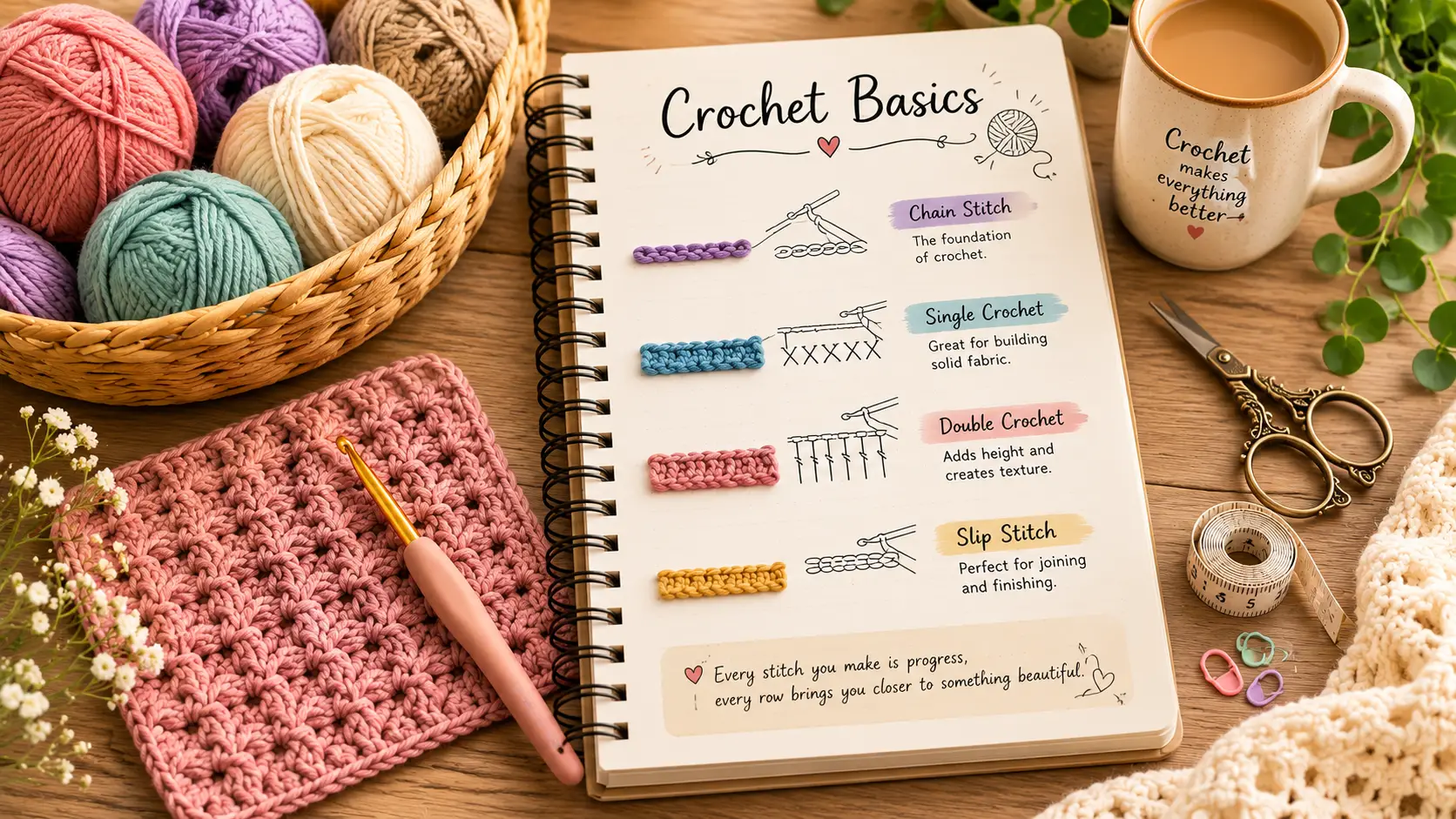
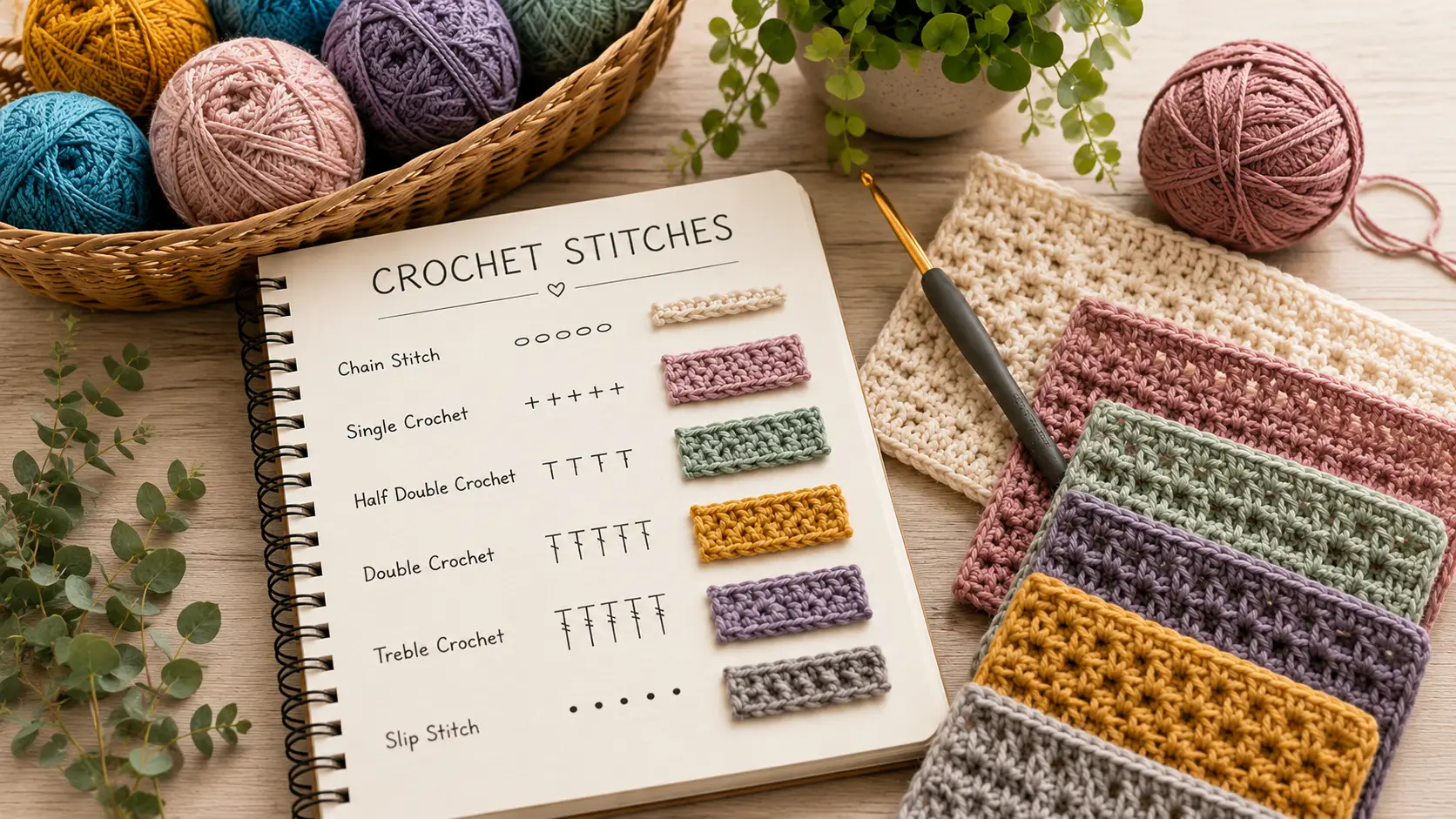
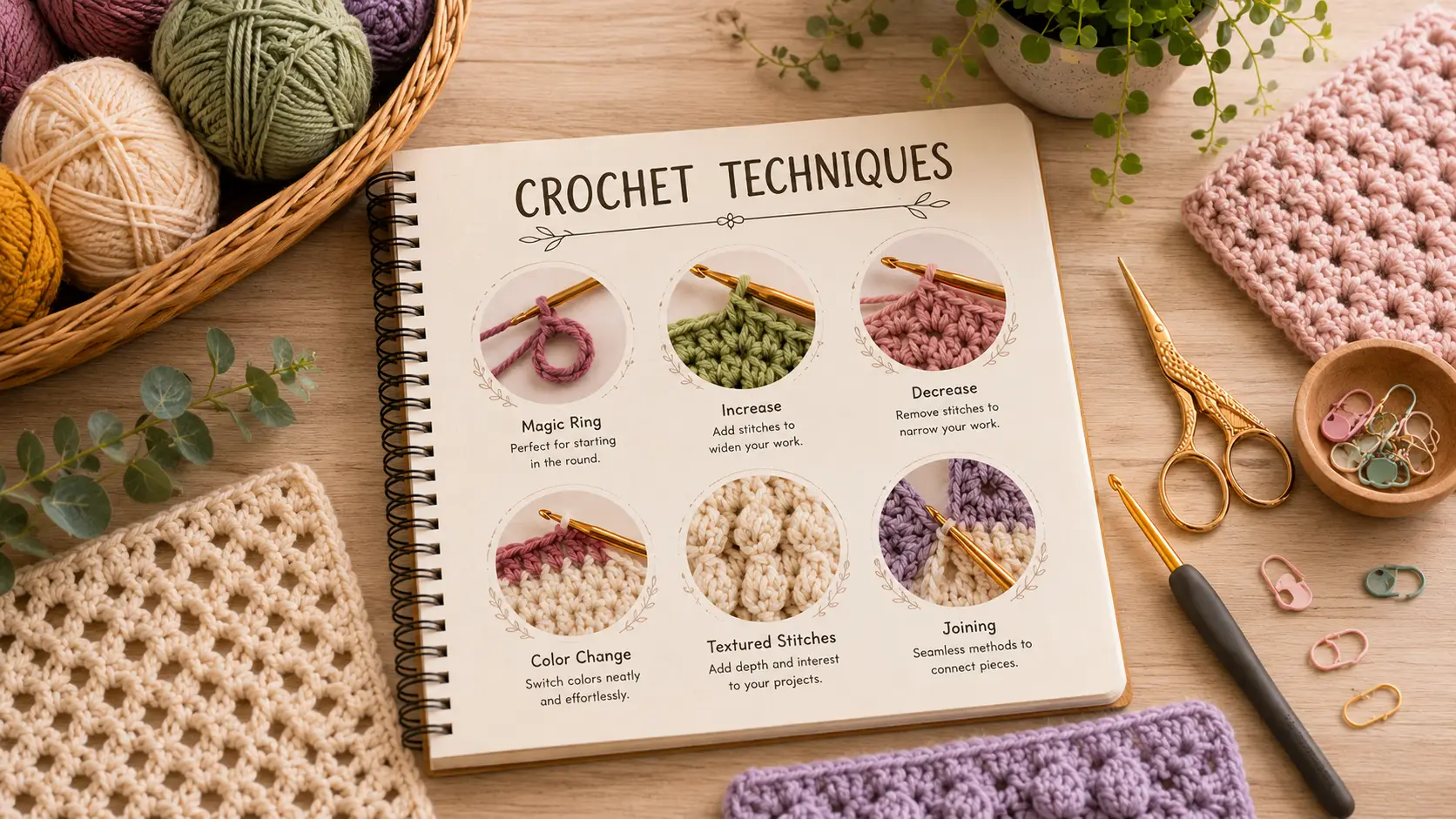
Begin With the Crochet Circle
The flat circle is the foundation of every round shape in crochet. Master it and spheres, ovals, cones, and amigurumi all follow.
Learn to Crochet a Circle →