Crochet Yarn, Demystified
Yarn is the single biggest factor in how your crochet looks, feels, and lasts. This is the master guide to choosing it well: what yarn weights mean, how fibers behave, how to read a label, and how to pick — or substitute — the perfect yarn for any project.
What Is Crochet Yarn?
Yarn is the raw material of crochet — long, continuous strands of twisted fiber that your hook turns into fabric. But not all yarn is the same. Yarn varies in two fundamental ways: its weight (how thick the strand is) and its fiber (what it is made of). Together, these two properties decide almost everything about your finished project — how warm it is, how it drapes, how it wears and washes, and even how easy it is to work with.
Choosing the right yarn is not a detail to rush past; it is one of the most consequential decisions in any project. The very same pattern and hook can produce a stiff, structured basket or a soft, flowing shawl depending entirely on the yarn. A stunning stitch pattern can be hidden by fuzzy yarn or shown off beautifully by a smooth one. And the wrong fiber can mean a hand-wash-only blanket for a baby, or a summer top that feels too warm to wear.
Understanding yarn also makes you a better pattern-follower. Patterns specify a yarn weight and often a fiber for good reason, and knowing how to read those requirements — and how to substitute safely when you want to — frees you to make any pattern in the yarn you love. Yarn knowledge pairs naturally with the hook and gauge fundamentals in our crochet basics, and with the crochet hooks that pair with each weight.
Weight + Fiber = Everything
A yarn's weight sets its thickness and the hook it needs; its fiber sets its warmth, drape, durability, and care. Learn to read these two properties and you can predict how any yarn will behave.
Yarn Drives Gauge
Because thickness and fiber affect stitch size, yarn is central to gauge — the stitches-per-inch that determine whether a project comes out the right size. Matching a pattern’s yarn weight is the first step to matching its gauge.
New to Crochet?
If you just need to know what to buy first, jump to best yarn for beginners — a smooth, light, medium-weight yarn is all you need to start.
Why Yarn Choice Makes or Breaks a Project
Yarn determines the drape of your fabric — whether it hangs softly like a shawl or stands firm like a basket. It determines warmth — a wool hat traps heat, while a cotton top breathes in summer. It determines durability and care — an acrylic baby blanket survives the washing machine, while a delicate alpaca scarf needs gentle hand-washing. None of these can be changed after the fact; they are chosen the moment you pick your yarn.
Yarn also shapes your experience of making. Smooth, light-colored yarn shows every stitch clearly, so mistakes are easy to see and fix; dark or fuzzy yarn hides the structure and makes learning harder. A splitty yarn frustrates the hook; a smooth one glides. The right yarn makes crocheting a pleasure, and the wrong one can make even a simple project feel like a fight — which is why experienced crocheters are so particular about it.
Finally, yarn is where cost and value live. Yarn is the main expense of most projects, and the range is enormous — from budget acrylic to luxury cashmere. Understanding fibers lets you spend wisely: choosing an affordable, washable yarn for a child’s toy, and saving a special skein for a garment that deserves it. Good yarn knowledge is good project planning.
Yarn Weights and Their Hook Pairings
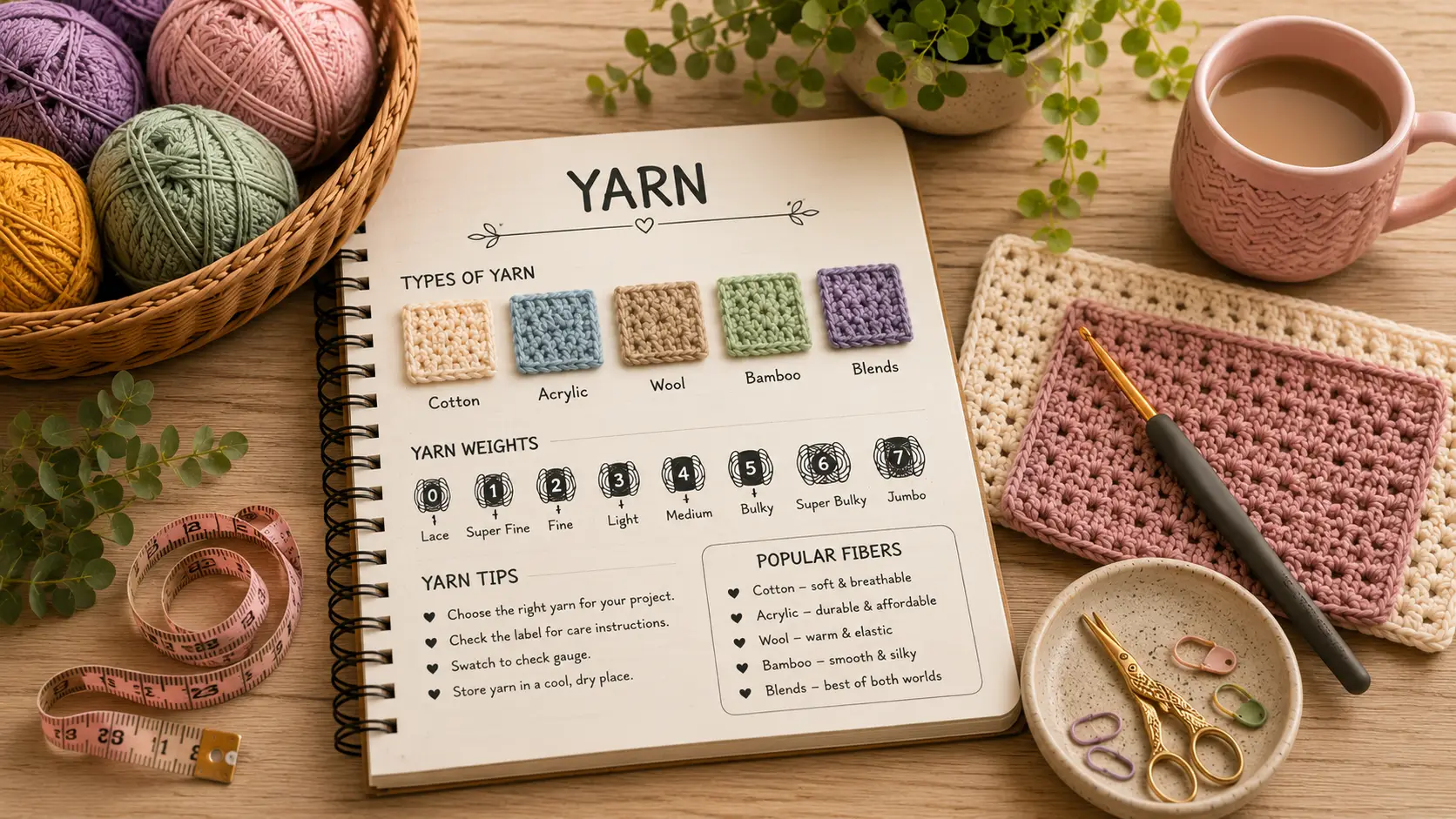
“Weight” means thickness, not how heavy the ball is. The Craft Yarn Council standardizes it from 0 (finest) to 7 (thickest), and each weight pairs with a range of hook sizes.
| # | Weight | Also Called | Hook Range | Best For |
|---|---|---|---|---|
| 0 | Lace | Thread, fingering, 2-ply | 1.5–2.25 mm | Doilies, fine lace, delicate shawls |
| 1 | Super Fine | Fingering, sock, baby | 2.25–3.5 mm | Socks, shawls, lightweight baby items |
| 2 | Fine | Sport, baby | 3.5–4.5 mm | Baby garments, light accessories |
| 3 | Light | DK, light worsted | 4.5–5.5 mm | Garments, hats, versatile projects |
| 4 | Medium | Worsted, aran, afghan | 5.5–6.5 mm | Blankets, hats, amigurumi — most common |
| 5 | Bulky | Chunky, craft, rug | 6.5–9 mm | Quick blankets, scarves, cowls |
| 6 | Super Bulky | Super chunky, roving | 9–15 mm | Chunky blankets, fast warm projects |
| 7 | Jumbo | Giant, arm yarn | 15 mm+ | Giant blankets, arm crochet, baskets |
Medium weight (#4, worsted) is the most popular and the friendliest for beginners — it pairs with a 5.0–5.5 mm hook and suits almost everything. For the full breakdown of each weight and its uses, see yarn weights explained, and match the hook in our crochet hooks guide.
The Four Families of Yarn Fiber
Fiber content is the other half of the yarn story. Every yarn belongs to one of these families, and the family tells you how it will feel, wear, and wash.
Animal Fibers
Wool, alpaca, mohair, cashmere, and merino. Warm, elastic, and springy with excellent stitch definition. They can felt with heat and agitation, and some are hand-wash only. Perfect for cozy garments, winter accessories, and anything that needs warmth and bounce.
Plant Fibers
Cotton, linen, bamboo, and hemp. Cool, breathable, strong, and crisp, with little stretch and beautiful drape. They show stitches sharply and hold their shape. Ideal for dishcloths, market bags, amigurumi, home décor, and summer wear.
Synthetic Fibers
Acrylic, nylon, and polyester. Affordable, durable, machine-washable, and available in every color. Soft and forgiving, they are the most beginner-friendly and the standard choice for blankets, toys, and everyday items that need easy care.
Blends
Combinations like wool-acrylic, cotton-acrylic, or wool-nylon. Blends balance the strengths of each fiber — the warmth of wool with the washability of acrylic, or the strength of nylon in sock yarn. Many of the best all-purpose yarns are blends.
Not sure which to pick? Compare the two most popular beginner fibers in cotton vs acrylic yarn, or explore all of them in types of yarn fiber.
Browse Every Yarn Guide
Each guide below goes deep on one part of choosing and using yarn — weights, fibers, labels, substitution, and care. Start wherever you need.
Yarn Weights Explained
The 0–7 weight system, what each weight is for, and the hook that pairs with it.
Read the guideBest Yarn for Beginners
Exactly what to buy for your first projects — and what to avoid while learning.
Read the guideTypes of Yarn Fiber
Animal, plant, synthetic, and blends — how each fiber behaves and what it suits.
Read the guideHow to Choose Yarn
Match yarn to your project by weight, fiber, drape, color, and care needs.
Read the guideHow to Read a Yarn Label
Decode every symbol and number — weight, gauge, yardage, dye lot, and care.
Read the guideHow Much Yarn Do I Need?
Estimate yardage for any project and never run out mid-row again.
Read the guideYarn Substitution Guide
Swap a pattern's yarn safely by matching weight, fiber, yardage, and gauge.
Read the guideCotton vs Acrylic Yarn
The two most popular beginner fibers compared — feel, care, cost, and best uses.
Read the guideWool Yarn Guide
Merino, superwash, felting, and why wool is the classic for warm garments.
Read the guideYarn Care & Washing
Wash, dry, and store finished pieces so they last — by fiber type.
Read the guideAll Crochet Yarn Guides
The complete, up-to-date list of every yarn guide on the site.
Yarn Care and Washing: Keep Your Crochet Looking New
How to care for and wash crochet by fiber type. Learn to read care symbols, hand wash and machine wash safely, dry and store finished pieces, and avoid shrinking and felting.
Wool Yarn Guide: Types, Uses, and Why Crocheters Love It
A complete wool yarn guide for crochet. Learn the types of wool, why it is warm and springy, how superwash and felting work, and the best projects for wool yarn.
Cotton vs Acrylic Yarn: Which Should You Crochet With?
Cotton vs acrylic yarn for crochet, compared. See how they differ in feel, warmth, drape, durability, care, and cost, and which is best for beginners and each project.
Yarn Substitution Guide: How to Swap Yarn in Any Pattern
A practical yarn substitution guide for crochet. Learn how to swap a pattern's yarn safely by matching weight, fiber, and yardage, and why a gauge swatch is essential.
How Much Yarn Do I Need? Estimating Yardage for Any Project
How much yarn do I need for a crochet project? Learn to estimate yardage by project type, use a gauge swatch, plan for dye lots, and avoid running out mid project.
How to Read a Yarn Label (and Why Every Detail Matters)
Learn how to read a yarn label. Decode the weight symbol, hook size, gauge, yardage, dye lot, and care symbols so you buy the right yarn and care for it correctly.
How to Choose Yarn for a Crochet Project (Step by Step)
How to choose yarn for any crochet project. A simple step by step method using weight, fiber, drape, color, and care so your finished piece looks and feels the way you want.
Types of Yarn Fiber: Animal, Plant, Synthetic, and Blends
A friendly guide to the types of yarn fiber for crochet. Learn how animal, plant, synthetic, and blended fibers feel, drape, wear, and wash, so you can pick the right one.
Best Yarn for Beginners: What to Buy for Your First Project
The best yarn for beginners is smooth, light colored, and medium weight. Here is exactly what to buy for your first crochet project, what to avoid, and why it makes learning easier.
Yarn Weights Explained: A Simple Guide From Lace to Jumbo
Yarn weights explained simply, from lace to jumbo. Learn what the 0 to 7 weight system means, which hook pairs with each weight, and how to pick the right thickness for your project.

Weight symbol
Hook size
Yardage
Dye lot
How to Read a Yarn Label
Every ball of yarn comes with a paper band packed with information. The weight symbol (a number 0–7 inside a skein icon) tells you the thickness. The recommended hook size gives your starting point. The gauge shows how many stitches and rows fit in four inches with that yarn and hook.
The label also lists the fiber content (for warmth, drape, and care), the length in yards and meters and the weight in grams or ounces (for figuring out how many balls you need), the color name and dye lot number, and care symbols for washing and drying.
Two details catch out beginners most. First, always buy enough balls of the same dye lot — the same color from different lots can vary subtly and show as a line in your work. Second, compare yardage, not ball count, when planning or substituting, since balls differ in length. Learn every symbol in how to read a yarn label.
Choosing Yarn for a Project
Start from the finished object you want. Ask four questions: How should it feel and drape — soft and flowing, or firm and structured? How will it be used and washed — a machine-washable everyday item, or a special hand-wash piece? What weight does the pattern call for? And what color and texture show the stitches the way you want?
Those answers point straight to a yarn. A drapey summer top wants a plant fiber in a light weight; a warm winter hat wants wool in worsted; a baby blanket wants a soft, washable acrylic or blend; an amigurumi toy wants a smooth cotton or acrylic in a firm gauge. Match the yarn to the job and the project almost makes itself. Our full method is in how to choose yarn.
Substituting Yarn in a Pattern
You will not always want — or be able — to use the exact yarn a pattern names, and that is fine. Safe substitution comes down to matching three things: the weight (most important), the fiber or a similar one (for drape and care), and the total yardage (so you buy enough). Get those right and most substitutions work beautifully.
The one non-negotiable step is a gauge swatch. Because different yarns of the same weight can still stitch up slightly differently, always crochet a swatch in your substitute and adjust your hook size until your gauge matches the pattern — especially for anything that must fit. Then your substitute yarn will produce the intended size. See the yarn substitution guide and estimate amounts with how much yarn do I need.
Common Yarn Mistakes
- Learning on dark or fuzzy yarn. It hides your stitches. Start with a smooth, light, solid worsted so you can see every loop.
- Ignoring the weight when substituting. Swapping a bulky for a worsted changes the size and drape completely. Match the weight first.
- Mixing dye lots. Buy all your yarn for a project in one dye lot, or a subtle color line can appear across the piece.
- Buying by ball count, not yardage. Balls vary in length. Compare total yards to be sure you have enough.
Caring for Yarn & Finished Pieces
Care depends entirely on fiber. Most acrylic and superwash wool is machine-washable and easy — one reason it is so popular for gifts and baby items. Untreated wool and delicate animal fibers usually need gentle hand-washing and flat drying, because heat and agitation cause felting. Cotton is hardy and washable but can shrink with high heat.
Always keep a yarn label (or note its care symbols) so you know how to wash the finished piece, and pass care instructions along when you give a handmade gift. Store yarn somewhere cool, dry, and out of direct sun, and protect animal fibers from moths. Good care is what turns a handmade item into an heirloom — a fitting finish to the work you put in with the techniques from our crochet techniques guide. Full details are in yarn care & washing.
Crochet Yarn: Frequently Asked Questions
What is the best yarn for beginners?
The best beginner yarn is a smooth, light-colored, medium-weight (worsted / #4) yarn in a wool, acrylic, or wool-acrylic blend. Smooth, solid, light yarn shows each stitch clearly so you can see and count your work, while medium weight pairs perfectly with a 5.0 mm hook. Avoid fuzzy, dark, or novelty yarns while learning.
What are the yarn weights?
Yarn weight refers to the thickness of the strand, standardized from 0 to 7: Lace (0), Super Fine / fingering (1), Fine / sport (2), Light / DK (3), Medium / worsted (4), Bulky / chunky (5), Super Bulky (6), and Jumbo (7). Medium (worsted) is the most common and most beginner-friendly weight.
What is the difference between acrylic and cotton yarn?
Acrylic is a soft, affordable, machine-washable synthetic that is warm and forgiving — ideal for blankets, beginners, and everyday items. Cotton is a plant fiber that is cool, breathable, durable, and crisp with little stretch — ideal for dishcloths, bags, amigurumi, and summer wear. Acrylic is stretchier and warmer; cotton is sturdier and cooler.
How do I know what hook size to use with my yarn?
Every yarn label suggests a hook size that suits that yarn's weight — this is your reliable starting point. As a rough guide: worsted (#4) uses about a 5.0–5.5 mm hook, DK (#3) about 4.0–5.0 mm, and bulky (#5) about 6.5–9 mm. Adjust up or down a size to match a pattern's gauge.
How much yarn do I need for a project?
A pattern states the yardage (or meters) required, not just the number of balls, because balls vary in length. Check the total yardage the pattern calls for and compare it to the yardage on your yarn's label. For your own designs, make a gauge swatch and estimate from how much yarn it used.
What does the ply of yarn mean?
Ply originally described how many individual strands (plies) are twisted together to make the yarn. Today it is an unreliable guide to thickness, because a 2-ply can be lace-weight or bulky depending on the strands. Use the standardized yarn weight number on the label rather than ply to judge thickness.
Can I substitute a different yarn in a pattern?
Yes, but match the substitute to the original's yarn weight and, ideally, its fiber and yardage. A worsted-weight cotton can replace a worsted-weight acrylic, but the drape and feel will change. Always make a gauge swatch in the new yarn and adjust your hook size until your gauge matches the pattern.
How do I read a yarn label?
A yarn label lists the fiber content, weight category and symbol, recommended hook and needle size, gauge, the length (yardage/meters) and weight (grams/ounces) of the ball, the color and dye lot number, and care instructions. The weight symbol, yardage, and dye lot are the details crocheters check most often.
Yarn Works With Everything
Pair your yarn knowledge with hooks, stitches, and techniques.
Get the Right Yarn for Your First Project
Skip the guesswork. A smooth, light, medium-weight yarn is the perfect place to begin — here is exactly what to look for.
Best Yarn for Beginners →